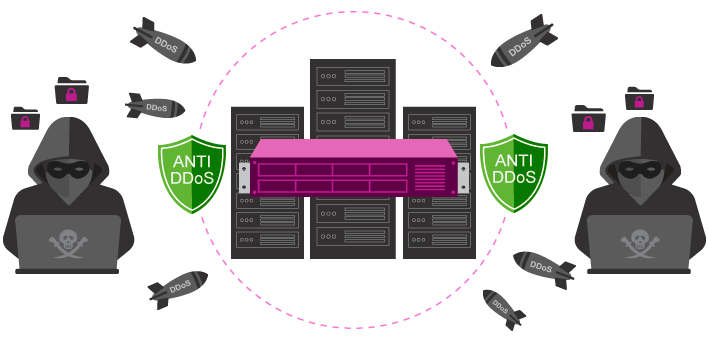
Anti-DDoS Attack Protection

  • Don't let malicious attacks stop you. Whether it is AI botnets, DNS attacks, UDP
  • amplification (layers 3 and 4) or HTTP attacks, we will protect your infrastructure,
  • your users and your domain and keep you resilient and available under every type of attack.
  • Our customers enjoy protection against the largest DDoS attacks. Try our
  • Anti-DDoS system to protect your network and applications against advanced attacks.

Our comprehensive DDoS protection

Only₪59 per month

  • High, flexible performance
  • High-capacity global network
  • Smart multi-layer protection
  • Minimal latency, scalable and easy, flexible deployment
  • Simple, fast implementation
  • Fixed price
  • Immediate provisioning

    Block every type of attack

  • Our Anti-DDoS service monitors all network requests
  • to block attacks on your origin servers, including: TCP
  • SYN + ACK, TCP FIN, TCP RESET, TCP SYN+ACK,
  • TCP FIN, TCP RESET, TCP ACK, TCP ACK+PSH, TCP
  • Fragment, UDP, Slowloris, Spoofing, ICMP, IGMP,
  • HTTP attacks, brute force, connection attacks,
  • DNS, NXDomain, Ping of Death, Smurf, Mixed SYN
  • UDP or ICMP + UDP flood, and more.
  • 10-second SLA

  • DNS CLOUD commits to an SLA of 10 seconds or less, regardless
  • of the type, size and duration of the attack, and with no added latency or
  • rerouting across our global network.

    What is a DDoS attack?

  • A Distributed Denial of Service attack is a long-standing type of attack on websites. The result is that the website cannot serve the visitors trying to access it. In milder cases there are severe disruptions and delays in the various services it is supposed to provide – loading pages, playing videos, running an online store and more.
  • How does a DDoS attack work?

  • Computer systems can serve only a limited number of users at any given time. Hackers exploit this fact in a DDoS attack. The attacked website is "flooded" with countless requests, as if there were far more visitors than it was built for. As a result, it cannot handle the load and cannot continue serving the real visitors trying to reach it. Often the attacking computers are assembled by hackers infecting many computers with malware. They then have what is called a botnet, or "zombie" network, that can be operated as they wish without the owners' knowledge. This attack network is triggered remotely at a set time against the website the attackers have targeted. The website owner of course needs to notice such situations and respond quickly. The website itself needs constant monitoring to know as early as possible if and when an attack is taking place, and every attack requires a fast, high-quality response. All these points actually require a dedicated, high-quality solution. More on this at the bottom of the article.
  • Common DDoS attacks

    • Volumetric attacks – This is an especially common type of attack and relatively easy to carry out. The idea is simply to flood the communication channels to the website – to exhaust the traffic volume it can handle. It is just like too many cars causing a traffic jam, or too many customers trying to enter a shop at once.

    • Application attacks – In these attacks, the target is not the communication but the server running the website. It is like a person who comes to a shop and asks for the product on the farthest, highest shelf, causing the staff maximum trouble – and this annoying request and similar ones are repeated again and again. As a result, even if the number of visitors is low, the server running the website is not free to handle them (because of the "pesky customer").

    • Attacks on communication protocols – These are unusual attack techniques that exploit known weaknesses in communication protocols. Such attacks are actually only one technical part among several in a broad DDoS attack, intended to strengthen the overall attack.

    What is the difference between a DoS attack and a DDoS attack?

  • The word "Distributed" in Distributed Denial of Service refers to a denial-of-service attack coming from a large collection of computers – a "distributed" attack setup – as opposed to a simple DoS attack, in which only one computer carries out the attack.
  • How can you defend against a DDoS attack?

  • Given today's growing focus on attacking web applications, the recommended solution also against DDoS attacks is DNS CLOUD's WAF service – a Web Application Firewall that provides effective protection against a variety of common attack types. Despite its power, it is easy to install and implement. Customizing it for you is simple thanks to an API and configurable rules. The WAF service automatically learns visitor behavior on the website (to detect suspicious anomalies), updates automatically, is managed through an easy-to-use dashboard and is standards-compliant.

DNS CLOUD protects your websites, networks and DNS servers to

Operational efficiency

Our global network has high capacity, includes scrubbing capability and handles large volumes of attacks quickly and with maximum efficiency. Our comprehensive protection methodology works great even with a small team.

Flexible design

Even if a DDoS attack hits your organization, you will stay online. We offer a variety of cloud- and hardware-based protection options to meet all your high technological needs and keep a DDoS attack from stopping you. With us you no longer need to worry about outages that happen within seconds and require hours of recovery.

Fully managed and self-tuning

Our system is always up to date on global threats and analyzes trends. There is no need to install or maintain specific features – we provide automatic dynamic signatures for fast and accurate threat detection and blocking.

WhatsApp Icon Talk to Us

Chat with us on WhatsApp

For orders and sales we are available on WhatsApp, Sunday–Thursday, 9:00 AM to 6:00 PM (Israel time). On Fridays, Saturdays and holidays, please use the support center on our website. Phone: +972-79-5599455